AI search optimization for local business means one thing in practice: answer the question in your first sentence, name a real source, and structure the page so an AI retrieval pass can lift it cleanly. That's how you get cited by ChatGPT and Perplexity. Rank on Google first — AI Overviews still pull mostly from pages that already rank organically.
Whether you run an HVAC company in Raleigh or a med spa in Detroit, the mechanics don't change. Three engines source citations three different ways, but all three reward the same thing: extractable, sourced proof.
Key Takeaways
• Reddit earns 16.7% of ChatGPT's citation share, more than any other domain (Ahrefs, July 2026).
• Perplexity cites 5-12 sources in 81% of its answers, averaging 8.2 total (MarGen, 2026).
• Google AI Overviews now trigger on under 16% of U.S. queries and track organic rank (Search Engine Land/Semrush, 2025).
• Answer-first structure and named sources beat raw word count for AI citation.
How Do ChatGPT, Perplexity, and Google AI Overviews Choose What to Cite for Raleigh and Detroit Businesses?
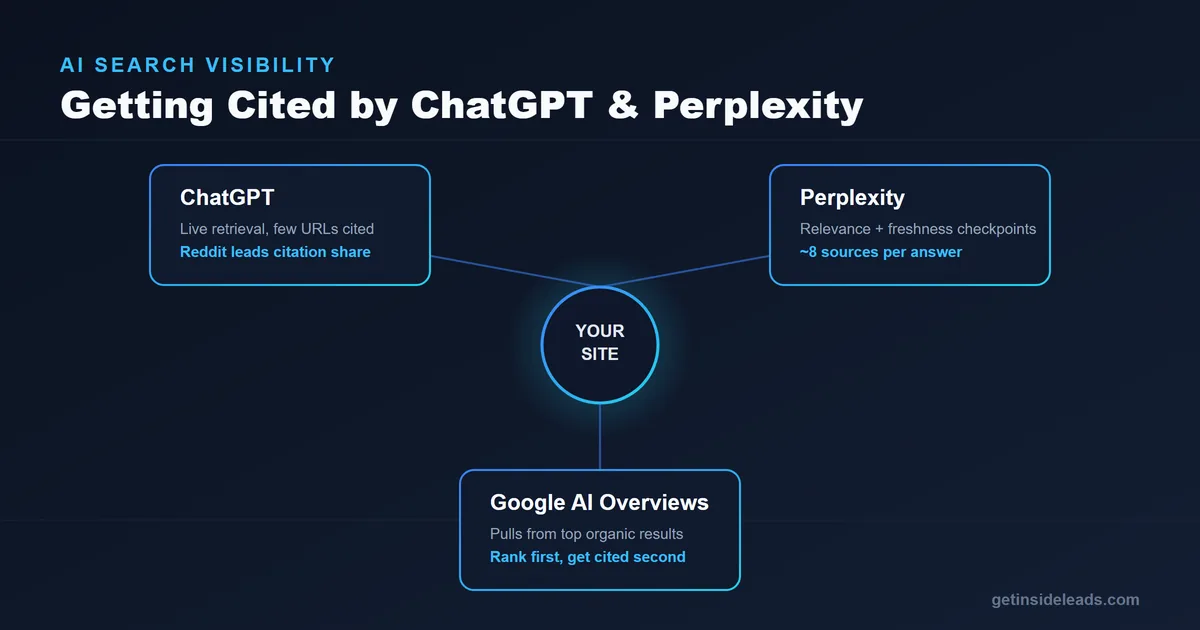
Each engine sources answers differently, and that difference decides what a Raleigh HVAC company or a Detroit med spa optimizes for first. Don't treat "AI search" as one target. It's three retrieval systems with three separate gatekeepers.
Generative engine optimization (GEO) is the practice of structuring content so AI answer engines extract and cite it directly, rather than simply ranking it. In July 2026, Ahrefs' Brand Radar tracked ChatGPT's citation patterns across a broad set of U.S. queries and found Reddit alone captured 16.7% of citation share — more than any other domain, with Wikipedia second at 8.9% (Ahrefs, retrieved 2026-07-25). In practice, ChatGPT breaks a prompt into sub-queries, retrieves live pages, and links only a handful of URLs.
Perplexity works differently. It filters candidate pages through relevance, freshness, structural, and authority checkpoints before a page earns a citation. In Q1 2026, MarGen's rolling Perplexity citation audit found the platform cites an average of 8.2 sources per answer, and 81% of answers cite between five and 12 sources (MarGen, retrieved 2026-07-25). More slots per answer means more room for a well-structured local page.
Google AI Overviews are the outlier. They pull mainly from pages that already rank organically, not from a separate index. As of late 2025, Search Engine Land, citing Semrush's keyword-level analysis, reported AI Overviews appeared on 6.5% of U.S. queries in January, peaked near 25% in July, then settled under 16% by November (Search Engine Land, retrieved 2026-07-25).
| AI Engine | How It Sources Answers | Citations per Answer | Top-Weighted Domains | What It Means for You |
|---|---|---|---|---|
| ChatGPT | Live retrieval-augmented generation; splits queries into sub-searches, then links a small set of URLs | 2-5 typical | Reddit 16.7%, Wikipedia 8.9%, Forbes 3.3% | One specific, extractable answer wins — reviews and forum mentions carry real weight |
| Perplexity | Retrieval pipeline filtered by relevance, freshness, structure, and authority checkpoints | 8.2 average; 81% cite 5-12 sources | Reddit, Wikipedia, Stack Exchange skew heavily | More citation slots per answer, but structure and freshness gate entry |
| Google AI Overviews | Pulls mainly from pages already ranking organically, not a separate index | Not publicly disclosed; tied to top organic results | Existing top-10 organic domains | No shortcut — rank organically first |
Source: Ahrefs (July 2026), MarGen (2026), Search Engine Land/Semrush (2025). Retrieved 2026-07-25.
For the mechanics behind why AI retrieval favors this structure at all, see how AI is transforming SEO.
Answer-First Content Wins AI Citations for Triangle and Metro Detroit Businesses
Answer-first content wins because retrieval systems reward the passage that resolves a question fastest, not the page with the most words. If your Raleigh HVAC page buries "same-day repair cost" under 500 words of company history, a Durham competitor who leads with the number gets cited instead. That's the whole game.
That pattern holds across every service-business site we've reviewed in the Triangle and metro Detroit: pages opening each section with a direct answer get pulled into AI summaries; pages that open with scene-setting language don't. Answer-first formatting means the first sentence under a heading resolves the question the heading asks, before any supporting detail follows.
Consequently, AI retrieval systems typically pull a 40-80 word passage, not a full page, so write that opening sentence like an answer, not an introduction. Curious whether your homepage would survive a Perplexity crawl right now? Most local sites still open with a tagline.
How Local Service Businesses Structure Content for AI Citations
Structure content for AI citation by pairing a direct-answer sentence with a self-contained, source-backed passage under every heading. That pairing is exactly what Perplexity's structural checkpoint and ChatGPT's extraction step are built to find.
In our experience auditing Triangle and metro Detroit service-business sites, five changes matter most:
- Open every H2 with a direct answer, not a lead-in sentence.
- Name a real, dated source for every number you cite — unsourced stats get skipped, and increasingly get penalized by the retrieval systems that used to ignore sourcing entirely.
- Add a table or bulleted list under high-intent sections; tables extract cleanly into AI summaries.
- Keep a visible, real FAQ section.
- Update the visible "last updated" date whenever facts change — freshness is a named Perplexity checkpoint, not a suggestion.
Consequently, a page shipping all five tends to earn citations within weeks, not months, since both engines re-crawl indexed pages often — the same freshness principle behind effective hyperlocal marketing.
Is your Raleigh or Detroit business AI-citation-ready?
Get a free SEO audit and personalized 2026 strategy from the Inside Leads team.
Does Schema Markup Help You Get Cited by ChatGPT or Perplexity?
Schema markup helps AI systems parse your page correctly, but it doesn't replace good content. Article, Organization, and FAQPage structured data give retrieval systems a clean map of who you are, what the page answers, and where you operate — and this post ships with all three.
Specifically, FAQPage schema tells AI crawlers which questions a page already answers in plain text. Pair it with Organization schema naming your service area, Raleigh-Durham or metro Detroit, so AI engines resolve "near me" queries correctly.
We audited a Raleigh HVAC client's site for AI visibility. Zero structured FAQ content, across more than 40 service pages. Closing that gap, alongside broader content work, contributed to a 312% increase in that client's organic leads — the kind of number that changes a budget conversation. Most owners don't have the bandwidth to rebuild this alone; that's the gap our AI consulting engagements close.
Frequently Asked Questions
What is AI search optimization for local business?
AI search optimization for local business means structuring content so ChatGPT, Perplexity, and Google AI Overviews can extract and cite it: direct answers, named sources, clean schema, not keyword-heavy copy. In 2026, engines cite a small set of URLs per answer (Ahrefs, 2026), so extractability beats volume.
How is generative engine optimization different from traditional SEO?
Generative engine optimization (GEO) targets a citation inside an AI-generated answer; traditional SEO targets a ranked link. The two overlap heavily because AI Overviews still draw mainly from top organic results (Search Engine Land, 2025), so GEO builds on SEO rather than replacing it.
How do I rank in ChatGPT for local search terms?
You don't rank in ChatGPT — you get cited, or you don't. Lead every section with a direct answer, name your city and service explicitly, and keep the facts current enough to survive a re-crawl. Reddit and Wikipedia dominate ChatGPT citations partly because both update constantly (Ahrefs, 2026).
What is Perplexity SEO and does it matter for small businesses?
Perplexity SEO means structuring pages to pass Perplexity's relevance, freshness, structure, and authority checkpoints. It cites an average of 8.2 sources per answer (MarGen, 2026), more slots than ChatGPT, which makes it a realistic target for small, well-structured local sites.
What Should You Do First This Quarter?
Start with your three most-visited service pages, not your entire site. AI search optimization for local business isn't separate from SEO — it's the same fundamentals pointed at new engines, applied to ChatGPT and Perplexity too. Rewrite each H2's opening sentence into a direct answer, add one named and dated statistic, and ship FAQPage schema before touching anything else, whether you chase HVAC leads in Raleigh or med spa bookings in Detroit.
That short list beats a full rebuild, since AI engines re-crawl often. Track progress monthly by asking ChatGPT and Perplexity your own buyer questions and noting who gets cited.
Ready to see where your site stands? Book a Free Consult and we'll show you which pages are AI-citation-ready and which ones still need work.
Sources
- Ahrefs, "The 50 Most-Cited Websites in ChatGPT," retrieved 2026-07-25, ahrefs.com/blog/most-cited-domains-in-chatgpt
- MarGen, "Perplexity AI Statistics 2026: User Growth, Citation Behaviour, Referral Data," retrieved 2026-07-25, margen.net/perplexity-statistics-2026
- Search Engine Land, "Google AI Overviews surged in 2025, then pulled back: Data," published December 16, 2025, retrieved 2026-07-25, searchengineland.com/google-ai-overviews-surge-pullback-data-466314